
2026~ (UNIST)
2022~2026 (University of Toronto)
Redox-decoupled electrolysis for direct air capture of CO2
S. Liu†; Y. Xiao†; D. Kim†; Z. Guo†; E. Grignon†; Y. Li; I. Munro; J. Edwards; J. Zhang; J. Liu; P. Papangelakis; Y. Che; H. S. Lee; F. Li; P. Sarma; J. Zhu; Q. Wang; C. Wang; T. Scheidt; R. K. Miao; D. Seferos; Y. Xu; D. Sinton
Nature Chemical Engineering, 2026, 3, 261–271
-
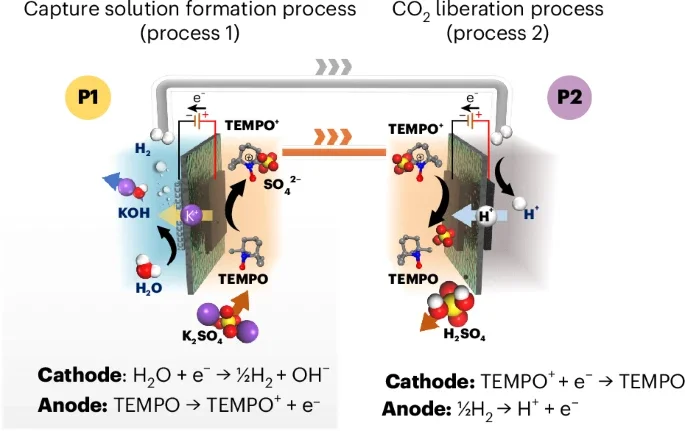
Electrochemical direct air capture (eDAC) leverages renewable electricity to remove atmospheric carbon dioxide (CO2), offering an alternative to carbon-intensive thermal methods. However, existing eDAC systems achieve high energy efficiency only when producing a dilute hydroxide stream (pH ≈ 13) that is incompatible with current air contactors. Attempts to generate more concentrated capture solutions encounter the fundamental limitation of proton and hydroxide recombination, lowering the current efficiency and increasing energy requirements. Here we present a decoupled strategy whereby CO2 liberation and sorbent regeneration are spatially separated, achieving high current and energy efficiency via redox-decoupled electrolysis. We tuned the redox mediator and synthesized a cation exchange membrane to ensure fast reaction kinetics, a low operating voltage and stability. The combined redox-decoupled approach achieved a capture-rate-normalized energy intensity of 0.22 GJ m2 yr t−2 (at 50 mA cm−2), a threefold improvement over previous work. Redox-decoupled eDAC provides an energy-efficient means of generating the concentrated alkaline capture solutions needed for large-scale direct air capture
Site-selective protonation enables efficient carbon monoxide electroreduction to acetate
X. Wang†; Y. Chen†; F. Li†; R. K. Miao†; J. E. Huang; Z. Zhao; X.-Y. Li; R. Dorakhan; S. Chu; J. Wu; S. Zheng; W. Ni; D. Kim; S. Park; Y. Liang; A. Ozden; P. Ou; Y. Hou; D. Sinton; E. H. Sargent
Nat. Commun., 2024, 15, 616–625
-
Electrosynthesis of acetate from CO offers the prospect of a low-carbon-intensity route to this valuable chemical but only once sufficient selectivity, reaction rate and stability are realized. It is a high priority to achieve the protonation of the relevant intermediates in a controlled fashion, and to achieve this while suppressing the competing hydrogen evolution reaction (HER) and while steering multicarbon (C2+) products to a single valuable product, an example of which is acetate. Here we report interface engineering to achieve solid/liquid/gas triple-phase interface regulation, and we find that it leads to site-selective protonation of intermediates and the preferential stabilization of the ketene intermediates: this, we find, leads to improved selectivity and energy efficiency toward acetate. Once we further tune the catalyst composition and also optimize for interfacial water management, we achieve a cadmium-copper catalyst that shows an acetate Faradaic efficiency (FE) of 75% with ultralow HER (<0.2% H2 FE) at 150 mA cm−2. We develop a high-pressure membrane electrode assembly system to increase CO coverage by controlling gas reactant distribution and achieve 86% acetate FE simultaneous with an acetate full-cell energy efficiency (EE) of 32%, the highest energy efficiency reported in direct acetate electrosynthesis.
Direct air capture of CO2 via cyclic viologen electrocatalysis
S. Liu†; J. Zhang†; F. Li†; J. P. Edwards†; Y. C. Xiao; D. Kim; P. Papangelakis; J. Kim; D. Elder; P. D. Luna; M. Fan; G. Lee; R. K. Miao; T. Ghosh; Y. Yan; Y. Chen; Y. Zhao; Z. Guo; C. Tian; P. Li; Y. Xu; E. H. Sargent; D. Sinton
Energy Environ. Sci., 2024, 17, 1266–1278
-
Electrochemical direct air capture (DAC) can leverage renewable electricity to reduce atmospheric CO2 levels via energy-efficient organic redox couples. However, current organic systems are threatened by oxidative degradation when explosed to air. In this work, we propose an electrochemical process to regenerate hydroxide absorbents via cyclic viologen electrocatalysis (CVE). This strategy isolates the redox-active viologens from the alkaline absorbents to avoid oxidative degradation and vaporization loss. Tuning the viologen substituent is needed to facilitate fast reaction kinetics in the electric fields present under reductive and oxidative environments. We show that di-polar viologens, which contain both positively and negatively charged groups, can overcome electric field repulsion during reduction and oxidation. We demonstrate a minimum work of 0.82 GJ per tCO2, calculated based on the cyclic voltammetry redox potentials, and a work as low as 3.8 GJ per tCO2 in a practical two-electrolyser CVE configuration with over 200 hours of stable operation.
High carbon efficiency in CO-to-alcohol electroreduction using a CO reservoir
S. Park†; I. Grigioni†; T. Alkayyali†; B. Lee; E. Shirzadi; J. Kim; R. Dorakhan; G. Lee; J. Abed; F. Bossola; E. D. Jung; Y. Liang; M. G. Lee; A. Shayesteh; D. Kim; D. Sinton; E. H. Sargent
Joule, 2023, 7,1–14
-
The electrochemical CO2 reduction reaction (CO2RR) has progressed but suffers an energy penalty from CO2 loss due to carbonate formation and crossover. Cascade CO2 to CO conversion followed by CO reduction addresses this issue, but the combined figures of carbon efficiency (CE), energy efficiency (EE), selectivity, and stability require improvement. We posited that increased CO availability near active catalytic sites could maintain selectivity even under CO-depleted conditions. Here, we present a heterojunction carbon reservoir catalyst (CRC) architecture that combines copper nanoparticles with porous carbon nanoparticles. The pyridinic and pyrrolic functionalities of CRC can absorb CO enabling high CE under CO-depleted conditions. With CRC catalyst, we achieve ethanol FE and CE of 50% and 93% (CE∗Faradaic efficiency [FE] = 47%) in flow cell at 200 mA cm−2, fully doubling the best prior CE∗FE to ethanol. In membrane electrode assembly (MEA) system, we show sustained efficiency over 85 h at 100 mA cm−2.
Small alkali cations direct CO electroreduction to hydrocarbons rather than oxygenates
W. Ni†; Y. Liang†; Y. Cao†; Z. Chen†; R. K. Miao; B. Peng; Z. Liu; Y. Liu; H. Ze; X. Wang; D. Kim; S. Park; J. Yu; P. Papangelakis; V. Boureau; M. Imran; Q. Wang; P. Ou; X.-Y. Li; K. Xie; R. Dorakhan; E. Shirzadi; G. C. Schatz; D. Sinton; J. Ge; J. Zeng; E. H. Sargent
Nature Chemistry, 2026, 18, 774–781
-
Electrochemical CO reduction has the potential to enable low-carbon-intensity chemicals and fuels, but the reaction yields a mixture of multi-carbon products, and the underlying selectivity-driving mechanisms are unclear. Here we explore trends in alkali cations and find, in contradistinction to carbon dioxide electroreduction, that lithium promotes ethylene production. We study the electrolyte–catalyst interface using operando Raman spectroscopy and simulations and find that hydrated Li+ on the electrode surface has the greatest hydrogen bonding and the least cation–dipole interaction with the oxygen site on intermediates. These interactions suppress hydrogenation on carbon and promote the competing hydrodeoxygenation reaction that leads to hydrocarbons. We leverage this understanding and reduce the oxygen affinity of copper via antimony doping, suppressing the formation of the O-tethered CHCHO* intermediate on the surface that would otherwise lead to oxygenates. Combining these strategies, we achieve an ethylene faradaic efficiency of 79% at 150 mA cm−2 and an energy efficiency of 39% in a membrane electrode assembly electrolyser.
Passive direct air capture via evaporative carbonate crystallization
D. Kim†; S. Liu†; T. Devasagayam; R. K. Miao; Y. Gao; J. Kim; H. S. Kim; K. Golovin; T. Scheidt; D. Sinton
Nature Chemical Engineering, 2025, 2, 736–746
-
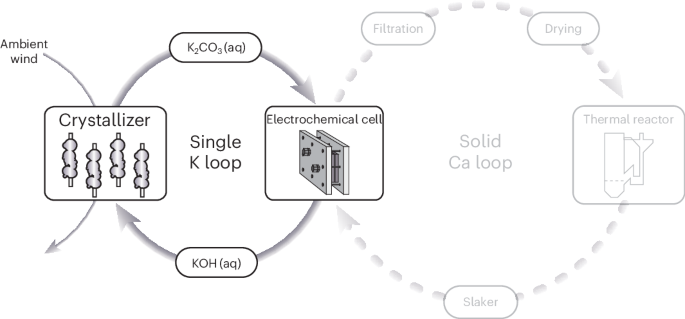
Direct air capture of CO2 is needed to mitigate past emissions and those of persistent and difficult-to-abate sources. Current liquid-sorbent-based direct air capture relies on large-scale air handling and coupled sorbent–solid chemical loops, but the complexity and cost of this approach are barriers to scaling. Here we report a departure from established capture mechanisms in which ultraconcentrated KOH solutions (>9 M) achieve rapid CO2-to-carbonate crystallization at the air interface. On the basis of this finding, we develop a carbonate crystallizer that leverages evaporation to concentrate KOH on a wicking substrate, enabling the stable, passive capture of atmospheric CO2 directly into a solid form. This approach achieves a capture flux over sixfold that of conventional systems, with regeneration demonstrated via a subsequent electrochemical step. A module with 100 such crystallizers achieved an average capture flux over threefold that of conventional contactors, with sustained operation over seven cycles and 25 days. This passive, single-chemical-loop approach has the potential to reduce capital and levelized costs by approximately 42% and 32%, respectively, compared with conventional liquid-based direct air capture systems.
Accelerated discovery of CO2-to-C3-hydrocarbon electrocatalysts with human-in-the-loop
J. Kim†, S. Mahesh†, H. S. Lee, R. Dorakhan, Y. Bai, M. Imran, K. Li, Y. Liu, D. Kim, S. Park, A. S. Zeraati, H. S. Moon, X. Li, F. Arabyarmohammadi, J. Abed, B. Wander, C. Wu, S. Liu, Y. C. Xiao, R. K. Miao, S. Hoogland, J. Hattrick-Simpers, E. H. Sargent, D. Sinton
Joule, 2025, 9, 102213-102226
-
Recent advances in automation and artificial intelligence have accelerated materials discovery, yet their implementation in heterogeneous electrocatalysts remains limited by challenges in integrating synthesis and performance evaluation, resulting in a lack of practically relevant data. This work establishes a human-in-the-loop accelerated discovery framework that couples robotic experimentation with interpretable machine learning, enabling human experts to refine model predictions during the search. The framework achieves a ∼165× acceleration in catalyst discovery, with ∼33× derived from accelerated experimentation and ∼5× from expert intervention. Applied to a 15-element compositional space, this framework enables the identification of Cu0.98In0.02 as a highly active CO2-to-C3-hydrocarbon electrocatalyst, achieving a propylene production rate of 42 mmol gcat−1 h−1 under neutral membrane electrode assembly (MEA) conditions. Analysis of 300 compositions further uncovers two mechanistic pathways—∗CO dimerization and ∗CHx-mediated coupling—demonstrating that merging automation, human domain expertise, and data-driven analysis can both accelerate discovery and reveal insights into complex catalytic systems.
Carbon- and energy-efficient ethanol electrosynthesis via interfacial cation enrichment
A. S. Zeraati†; F. Li†; T. Alkayyali†; R. Dorakhan†; E. Shirzadi; F. Arabyarmohammadi; C. P. O’Brien; C. M. Gabardo; J. Kong; A. Ozden; M. Zargartalebi; Y. Zhao; L. Fan; P. Papangelakis; D. Kim; S. Park; R. K. Miao; J. P. Edwards; D. Young; A. H. Ip; E. H. Sargent; D. Sinton
Nat. Synth., 2025, 4, 75–83
-
The use of acidic electrolytes in CO2 reduction avoids costly carbonate loss. However, the energy efficiency of acid-fed electrolysers has been limited by high hydrogen production and operating potentials. We find that these stem from the lack of alkali cations at the catalyst surface, limiting CO2 and CO adsorption. In acid-fed membrane electrode assembly systems, the incorporation of these cations is challenging as there is no flowing catholyte. Here an interfacial cation matrix (ICM)–catalyst heterojunction is designed that directly attaches to the catalyst layer. The negatively charged nature of the ICM enriches the alkali cation concentration near the cathode surface, trapping generated hydroxide ions. This increases the local electric field and pH, increasing multi-carbon production. Integrating the ICM strategy with a tailored copper–silver catalyst enables selective ethanol production through a proton-spillover mechanism. We report a 45% CO2-to-ethanol Faradaic efficiency at 200 mA cm−2, carbon efficiency of 63%, full-cell ethanol energy efficiency of 15% (3-fold improvement over the best previous acidic CO2 reduction value) and energy cost of 260 GJ per tonne ethanol, the lowest among reported ethanol-producing CO2 electrolysers.
Atomic-level Cu active sites enable energy-efficient CO2 electroreduction to multicarbon products in strong acid
L. Fan†; F. Li†; T. Liu††; J. E. Huang; R. K. Miao; Y. Yan; S. Feng; C. W. Tai; S. F. Hung; H. J. Tsai; M. C. Chen; Y. Bai; D. Kim; S. Park; P. Papangelakis; C. Wu; A. S. Zeraati; R. Dorakhan; L. Sun; D. Sinton; E. Sargent
Nat. Synth., 2025, 4, 262–270
-
Electrochemical CO2 reduction provides a promising strategy to synthesize C2+ compounds with reduced carbon intensity; however, high overall energy consumption restricts practical implementation. Using acidic media enables high CO2 utilization and low liquid product crossover, but to date has suffered low C2+ product selectivity. Here we hypothesize that adjacent pairs of atomic-copper active sites may favour C–C coupling, thus facilitating C2+ product formation. We construct tandem electrocatalysts with two distinct classes of active sites, the first for CO2 to CO, and the second, a dual-atomic-site catalyst, for CO to C2+. This leads to an ethanol Faradaic efficiency of 46% and a C2+ product Faradaic efficiency of 91% at 150 mA cm−2 in an acidic CO2 reduction reaction. We document a CO2 single-pass utilization of 78% and an energy efficiency of 30% towards C2+ products; an ethanol crossover rate of 5%; and an ethanol product concentration of 4.5%, resulting in an exceptionally low projected energy cost of 249 GJ t−1 for the electrosynthesis of ethanol via the CO2 reduction reaction.
Acid-stable Cu cluster precatalysts enable high energy and carbon efficiency in CO2 electroreduction
D. Kim†; S. Park†; J. Lee†; Y. Chen†; F. Li; J. Kim; Y. Bai; H. H. Huang; S. Liu; E. D. Jung; B. Lee; P. Papangelakis; W. Ni; T. Alkayyali; R. K. Miao; P. Li; Y. Liang; A. S. Zeraati; R. Dorakhan; D. M. Meira; Y. Chen; D. Sinton; M. Zhong; E. H. Sargent
J. Am. Chem. Soc., 2024, 146, 40, 27701-27712
-
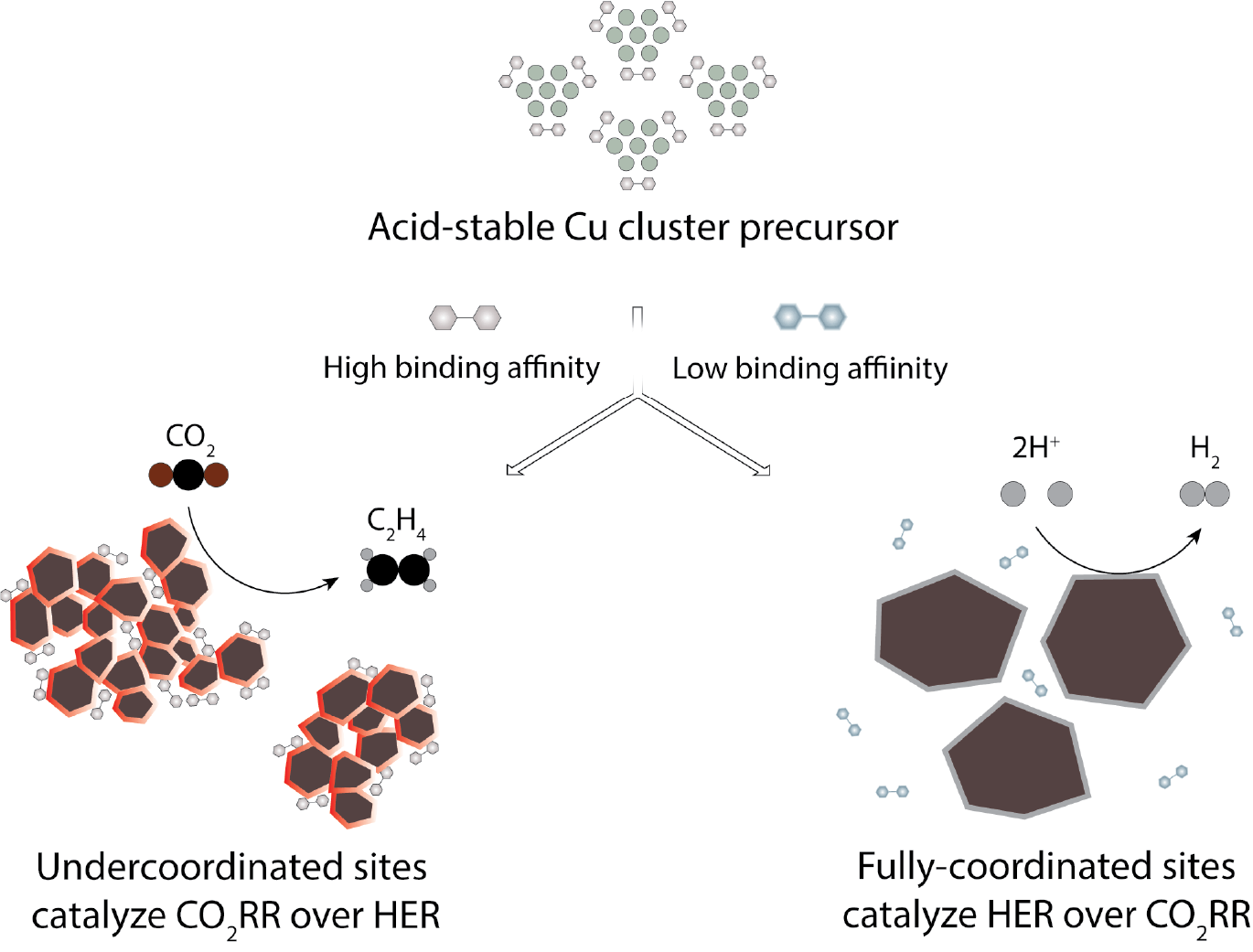
The electrochemical reduction of CO2 in acidic media offers the advantage of high carbon utilization, but achieving high selectivity to C2+ products at a low overpotential remains a challenge. We identified the chemical instability of oxide-derived Cu catalysts as a reason that advances in neutral/alkaline electrolysis do not translate to acidic conditions. In acid, Cu ions leach from Cu oxides, leading to the deactivation of the C2+-active sites of Cu nanoparticles. This prompted us to design acid-stable Cu cluster precatalysts that are reduced in situ to active Cu nanoparticles in strong acid. Operando Raman and X-ray spectroscopy indicated that the bonding between the Cu cluster precatalyst ligand and in situ formed Cu nanoparticles preserves a high density of undercoordinated Cu sites, resulting in a C2H4 Faradaic efficiency of 62% at a low overpotential. The result is a 1.4-fold increase in energy efficiency compared with previous acidic CO2-to-C2+ electrocatalytic systems.
2014~2016 (SNU)
D. Kim; D. R. Whang; S. Y. Park, Self-healing of molecular catalyst and photosensitizer on Metal-Organic Framework: Robust molecular system for photocatalytic H2 evolution from water, J. Am. Chem. Soc., 2016, 138, 28, 8698
2016~2022 (MIT)
H. G. Seo; A. Staerz; G. Dimitrakopoulos; D. Kim; B. Yildiz; H. Tuller, Degradation and recovery of solid oxide fuel cell performance by control of cathode surface acidity: Case study – impact of Cr followed by Ca infiltration, Journal of Power Sources, 2023, 558, 232589
F. Grajkowski; S. Chandra; G. Dimitrakopoulos; D. Kim; B. Yildiz, Exploring Stable and Selective Anode Materials for the Electrochemical Oxidative Coupling of Methane (EOCM): A Case Study of Doped Titanates, ECS Transactions 2023, 111 (6), 2259
D. Kim; A. Hunt; I. Waluyo; B. Yildiz, Cation deficiency enables reversal of dopant segregation at perovskite oxide surfaces under anodic potential, Journal of Materials Chemistry A, 2023, 11, 7299
D. Kim; G. Dimitrakopoulos; B. Yildiz, Controlling the size of Au nanoparticles on oxide supports with electrochemical potential, J. Am. Chem. Soc., 2022, 144,48, 21926
R. Bliem†; D. Kim†; J. Wang; E. J. Crumlin; B. Yildiz, Hf deposition stabilizes the surface chemistry of perovskite manganite oxide, J. Phys. Chem. C, 2021, 125, 6, 3346
D. Kim†; R. Bliem†; F. Hess†; J.-J. Gallet; B. Yildiz, Electrochemical polarization dependence of the elastic and electrostatic driving forces to aliovalent dopant segregation on LaMnO3, J. Am. Chem. Soc., 2020, 142, 7, 3548
Y. Kim; D. Kim; R. Bliem; G. Vardar; I. Waluyo; A. Hunt; J. T. Wright; J. P. Katsoudas; B. Yildiz, Thermally driven interfacial degradation between Li7La3Zr2O12 electrolyte and LiNi0.6Mn0.2Co0.2O2 cathode, Chem. Mater., 2020, 32, 22, 9531
X. Yao; K. Klyukin; W. Lu; M. Onen; S. Ryu; D. Kim; N. Emond; I. Waluyo; A. Hunt; J. A. D. Alamo; J. Li; B. Yildiz, Protonic solid-state electrochemical synapse for physical neural networks, Nat. Commun., 2020, 11, 1, 1